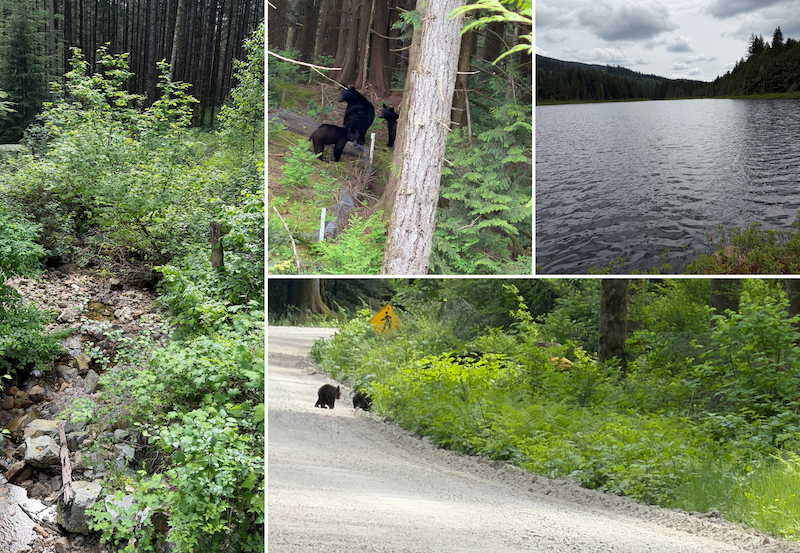
Recently, a few friends and I decided to spend a day in nature, a 6 km hike along a forestry road to a lake in a local reserve. It was a beautiful day, good company, and exactly the kind of reset a busy schedule demands. What we didn’t anticipate was coming home with a story we’d be telling for years.
On our return journey, we spotted our first momma bear and her cubs down an embankment and tucked into the trees. No real danger, just a thrill. We stopped, took some pictures alongside a fellow solo hiker who had caught up with us, and carried on feeling quietly triumphant. Wildlife sighting ✅
About twenty minutes later, that same solo hiker, now a few hundred yards ahead of us, rounded a corner, waved his arms, turned around, and headed back our direction. When he reached us, his first words were: “Does anyone have bear spray?”
Around the bend was a second momma bear with her cub. And this one, in his words, was a ‘Big Momma!’
Fortunately, someone in our group did have bear spray. Unfortunately, no one felt especially inclined to get close enough to deploy it. So we improvised, making noise with everything we had, including high-pitched whistle sounds played from our phones. After a few tense minutes and more than a few cautious glances around the corner, the pair moved off into the bush. We kept the noise going until we felt enough distance had passed, then carried on.
By the time we reached the final stretch of the trail, close enough to hear sounds of civilization and knowing the car park was just ahead, we had all mentally exhaled. The worst, surely, was behind us.
It wasn’t.
Our solo hiker had again moved ahead of us when he turned around once more. And there, just before the finish line, was momma bear number three, this time with two very young cubs. We ran the same playbook. The trio eventually moved into the bush and a few minutes later, we reached our cars, climbed in, thankful for a safe, albeit eventful, journey.
Three bears, one hike, one very important question: “Does anyone have bear spray?”
That question has stayed with me. Not just as a hiking lesson, but as a business one.
How often do we set out on a path assuming someone else has the essential tool? How often do we get deep into a project, a season, or a growth phase before realizing we’re missing a critical piece of preparation? And how often does the danger show up not at the hard part of the journey, but right near the end, when we’ve already relaxed?
Here’s what that hike reminded me about running a small business:
The gear you don’t have ready doesn’t count. Not being able to use bear spray is nearly as useless as no bear spray at all. The same is true for systems, processes, and support structures that exist in theory but aren’t actually in place when you need them. A back-up plan that lives in your head isn’t really a backup plan.
Groups create a false sense of coverage. In a group of five, everyone assumes someone else packed the essentials. In a small business, that same logic applies. If you’re the only one responsible for everything, there are no assumptions to hide behind. The gaps are yours to find before they find you.
“Almost there” is its own danger zone. The third bear appeared when we were closest to the car park, when we had already decided we were safe. In business, this shows up as the client you stop checking in with because things are going smoothly, the contract you don’t renew because it feels automatic, or the system you don’t back up because it hasn’t failed yet.
Improvisation works better when you’ve thought ahead. We used our phones because someone had the presence of mind to remember that high-pitched sounds deter bears. That’s not pure improvisation, that’s prior knowledge applied under pressure. Business owners who navigate crises well aren’t just fortunate. They’ve thought through scenarios, even loosely, before they happened.
A moment to reflect
Before you head into the second half of your year, it’s worth asking yourself a version of that question on the trail:
If something unexpected rounded the corner today, a key client pausing, a system failure, a sudden surge in demand, do you have what you need to handle it?
Not someday, but right now.
If the honest answer gives you pause, that’s not a reason for alarm. It’s just good information. The best time to prepare is always before you need to.
It wasn’t raining when Noah built the ark. – Howard Ruff